Building Services Newsletter
WELCOME TO THE BUILDING SERVICES NEWSLETTER

Welcome the Building Services Newsletter.  

Thank you for the work that you do and our partnership ensuring the life, health, and safety of everyone who lives, works, and plays in Fort Collins. If you have any feedback for us on how we can continue to improve our services and processes, please, don’t hesitate to reach out.     

Additionally, if there is any material, news, or updates you feel would be beneficial to include in the next newsletter, let us know.  

Best, 

Marcus Coldiron

Chief Building Official   

City of Fort Collins  

970-416-2324  

REMINDERS

BUILDING PERMIT EXPIRATIONS:

  • Per section R105.5 of the 2021 IRC and IBC, every permit issued will become invalid unless work authorized by such permit is commenced within 180 days after its issuance or if more than 180 days pass between inspections. 
    • Extensions will only be considered on a limited basis when justifiable cause can be demonstrated.  

HEADS UP! STOCK PLAN HOLDERS:

  • The 2024 I-codes will be proposed to be adopted by the end of this year. Drafts of the 2024 codes will be posted on our website soon. Keep in mind that all stock plans must be updated to the new codes, once adopted. New permits will not be issued without updated stock plans following the adoption of new codes.  

2024 I-CODES ADOPTION UPDATE

The 2024 Building Codes adoption is still underway. With the Code Adoption Committee finishing at the end of July we have been busy with additional public outreach. We held a Council work session on September 9th and have been meeting with various boards, commissions and other stakeholder groups from August and will continue through November.  

First reading of the adoption of the building codes will be held at the regular council meeting on December 2nd with second reading following on December 16th, on track for adoption by the end of this year.  

For more information regarding the adoption, including a timeline, recordings of each committee meeting and stakeholder group visits please visit https://www.fcgov.com/building/building-news. Drafts of the new proposed codes should also be available here in the next few weeks.   

If you have any thoughts or feedback on our local building codes and the adoption of the 2024 I-Codes, let us know at buildingcodeadoption@fcgov.com.  

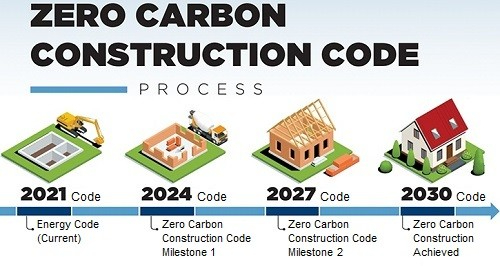
PERFORMANCE CODE PATH TO ZERO CARBON NEW CONSTRUCTION BY 2030

Development of the Fort Collins Code Path to Zero Carbon New Construction by 2030 has wrapped up and it’s likely that heat pumps will be increasingly important in the path to compliance. Interested in learning more about heat pumps? Several webinars can be found at a Colorado Energy Office video channel. And don’t forget about The City of Fort Collins Building Industry Scholarship program. Additional info in this newsletter.

The building code team has engaged in a City Council work session and is continuing engagement with boards, commissions and external organizations.

Visit: https://ourcity.fcgov.com/zero-carbon-construction-code to follow the progress, share thoughts and engage with city staff. You can also access this site through the “Learn more or engage with staff” link at www.fcgov.com/zerocarboncode.

BUILDING INDUSTRY WORKFORCE TRAINING FUNDS AVAILABLE

The City of Fort Collins offers scholarship funding to further educate and expand local industry workforce on energy efficiency, zero energy, and high-performance building. Individuals can apply for up to $1,200 and businesses or organizations can get up to $2,500 annually.

For scholarship info, or to apply for funding visit www.fcgov.com/buildingscholarship

CHIEF BUILDING OFFICIAL - INTERPRETATIONS:

In some cases, building codes are not explicitly clear in their intent and purpose. CBO interpretations are intended to provide clarity and consistency for staff and our customers. These interpretations can be found here -> Codes - City of Fort Collins (fcgov.com) in the drop-down menu near the top of the page. Here is the most recent:  

Title:                    Public vs. private toilet facilities  

Code Edition:     21’ International Plumbing Code (IPC)  

Sections:           

  • 202 General Definitions (IPC)  
  • 403.3 Employee and public toilet facilities (IPC)
  • 403.3.1 Access (IPC)  

Purpose: Provide clarification on the intent of public vs. private toilet facilities in accordance with the International Plumbing Code.  

Code requirements:  

PRIVATE. In the classification of plumbing fixtures, “private” applies to fixtures that are not public.  

PUBLIC OR PUBLIC UTILIZATION. In the classification of plumbing fixtures, “public” applies to fixtures with unrestricted exposure to walk-in traffic.  

403.3 Employee and public toilet facilities. For structures and tenant spaces intended for public utilization, customers, patrons and visitors shall be provided with public toilet facilities. Employees associated with structures and tenant spaces shall be provided with toilet facilities. The number of plumbing fixtures located within the required toilet facilities shall be provided in accordance with Section 403 for all users. Employee toilet facilities shall be either separate or combined employee and public toilet facilities.  

Exception: Public toilet facilities shall not be required for:  

      1. Parking garages operated without parking attendants.  

      2. Structures and tenant spaces intended for quick transactions, including takeout, pickup and drop-off, having a public access area less than or equal to 300 square feet (28 m2).
CONTINUED: Chief Building Official - Interpretations

CONTINUED from previous section

403.3.1 Access. The route to the public toilet facilities required by Section 403.3 shall not pass through kitchens, storage rooms or closets. Access to the required facilities shall be from within the building or from the exterior of the building. The public shall have access to the required toilet facilities at all times that the building is occupied.

Code Interpretation:  

Plumbing fixture calculations utilize occupant load in determining how many fixtures are required. Section 403.3 does provide the ability to separate public and employee toilet facilities. However, employee plumbing fixtures shall also be considered public, as the fixtures still provide unrestricted exposure to walk-in-traffic, unless their use is restricted to an individual, such as those of a private office.     

Restrooms in businesses such as doctors’ offices, dentists or similar uses that provide limited or appointed based access to certain areas, or the entirety of the space shall be considered public, unless the use is restricted to an individual, such as those of a private office.  

Building Services
281 N College
Fort Collins, CO 80524