Soapstone Natural Area and the Lindenmeier National Historic Landmark
In 2004, the City of Fort Collins purchased more than 20,000 acres of land north of town, near the Wyoming border. Now Soapstone Natural Area, this land supports thousands of acres of shortgrass prairie, the remains of historic homesteads, and the Lindenmeier Archaeological Site, a large prehistoric campsite more than 12,000 years old that is listed as a National Historic Landmark.
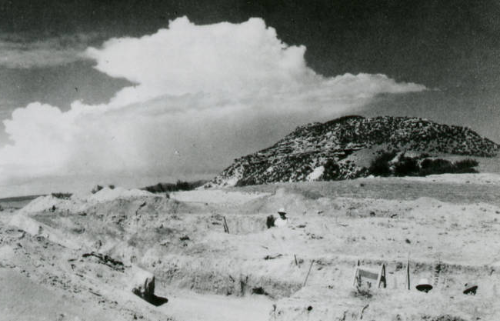
In 1924, amateur archaeologists Judge Claude Coffin, his son, Lynn Coffin and their friend C. K. Collins came upon some unusual fluted stone points while walking on the land of local rancher, William Lindenmeier. The Coffins invited to the site a professional archaeologist from the University of Denver who noted that the stone points looked similar to ones discovered near Folsom, New Mexico a few years earlier. In 1935, the Smithsonian sponsored an excavation at the site which helped to prove that humans had lived in North America since the Ice Age.
About 12,000 years ago, a group of people camped along a stream near what is now the border between Wyoming and Colorado. Their campsite had excellent views to the south along the Front Range and to the east over the plains. While camping here, these ancient humans made tools and weapons, hunted and processed meat, gathered edible plants, cooked food, tanned leather, sewed and decorated clothes, and enjoyed each other’s company around the fire. It’s likely that generations of people camped on the site, returning year after year to the same location. The descendants of Indigenous people continue to live in our communities today.
Visitors to Soapstone Natural Area can view the Lindenmeier site, touch reproductions of uncovered artifacts, and may catch a glimpse of the Laramie Foothills Bison Conservation Herd. Descended from the Yellowstone National Park herd, the bison at Soapstone and Red Mountain Open Space were reintroduced in 2015 through a collaboration with the City of Fort Collins, Colorado State University, and Larimer County. Every spring, elders and spiritual leaders of local Indigenous tribes visit the natural area to bless the bison herd and their offspring.
A National Historic Landmark (NHL) is a building, district, object, site, or structure officially recognized by the United States government for outstanding historical significance. Only 3 percent of places listed on the National Register of Historic Places are also listed as National Historic Landmarks. The Lindenmeier site is one of only 29 NHLs in Colorado, and one of only two NHLs in Larimer County.
Learn more about the Laramie Foothills Bison Conservation Herd, Soapstone Natural Area, and the Lindenmeier Archaeological Site.
(Photo: "Lindenmeier Excavations," 1936, H06553, Fort Collins History Connection, https://fchc.contentdm.oclc.org/digital/collection/ph/id/36383/rec/6.)