News from Historic Preservation Services
Historic Preservation Matters Newsletter
Latest Updates
  • Join the Martin Luther King Jr. Day Community Celebration at the Lory Student Center on Jan. 19, starting at 10 a.m.! Enjoy music, volunteer during a Day of Service to support clothes donations to Homeward Alliance, paint a community mural, explore a pop-up exhibit from Historic Preservation Services, experience the power of storytelling, and engage with the history of civil rights in Fort Collins by taking a virtual tour of historic places.
  • New year, new email! Historic Preservation Services can now be reached at preservation@fortcollins.gov. Check out the feature on our new website below. 

Are you a historic property owner?

Contact Historic Preservation Services (preservation@fortcollins.gov; 970-224-6078) to learn more about financial support programs for qualifying rehabilitation work and for information on required design review.

Last Month's Historic Preservation Commission (HPC) Decisions

The December HPC meeting was canceled due to lack of business.

Meet the New Website!

Launched Dec. 10, the City's new website is designed to help you find what you need quickly and confidently. The official .gov domain underscores reliable and accurate information, while clear navigation and simplified information make exploring City programs and services easy. With fully-accessible features and customer-focused design, FortCollins.gov was built with our community in mind. Stay informed and connect with your City through FortCollins.gov!

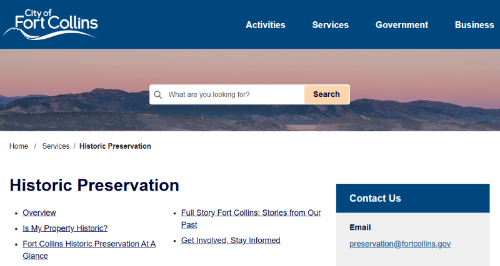
Check out the new Historic Preservation Services website!

Historic Resource Spotlight

Unity, Building Community, and Civil Rights: LULAC Hall, 234 N. Grant Avenue

What is “LULAC?”

LULAC stands for the League of United Latin American Citizens. Mexican American residents of Corpus Christi, Texas founded LULAC in February 1929 as a civil rights advocacy organization to address racial discrimination, political disenfranchisement, and racial segregation. The organization grew to become the largest and oldest civil rights organization for Hispanic Americans in the United States. The organization and its chapters around the country took actions small and large in the cause for civil rights. Nationally, they led legal actions that resulted in landmark cases to root out racial discrimination, especially in public schools, such as Hernandez v. Driscoll Consolidated ISD in 1957 (outside Corpus Christi) that ended racial discrimination in Texas public schools, and the Supreme Court case Hernandez v. State of Texas that ended racial discrimination against Hispanic Americans, specifically protecting the right of Hispanic Americans to serve on juries.

Here in Fort Collins, local residents including William Lopez, Richard Maxwell and Joe Gutierrez, founded a LULAC chapter in 1969 that was similarly involved in civil rights advocacy, challenging local authorities on the issues of school, employment, and housing discrimination, and engaging in community-building work. Formed in early 1969, Fort Collins’ LULAC members immediately challenged the school district for an equitable share of construction funds for new schools in heavily Hispanic neighborhoods. They challenged the City of Fort Collins on multiple cases of police brutality. They also co-hosted events with community groups to raise awareness about Mexican American and broader Latino/Chicano culture and its importance in American history.

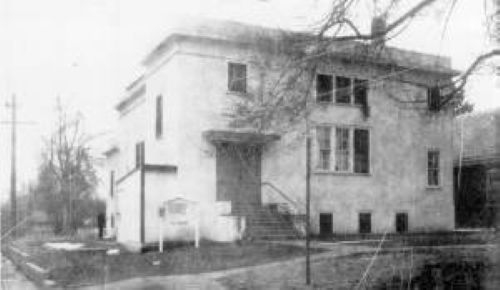
In its first few months LULAC held meetings at the Holy Family Church parish hall on North Whitcomb Street or the Knights of Columbus Hall on North Meldrum Street. However, by 1970 they had acquired the former Second (or Westside) Presbyterian Church at 234 North Grant Avenue and officially re-titled it the LULAC Hall. Here, the chapter held regular meetings, organized events and demonstrations and provided a community hall for local residents of all ages to come and socialize. In June 1970, the chapter hosted candidates of the La Raza Party (also known as La Raza Unida) running for local District Attorney and Colorado Governor. La Raza formed in 1970 in Texas and quickly spread throughout the country in an attempt to present a third-party option for Mexican Americans.

The later history of the LULAC Hall is unclear, but by 1980 the hall had been sold and renovated into a six-unit condominium. The building remains on its historic location in the neighborhood, albeit with a different look than its former life as a hub of civil rights activity.

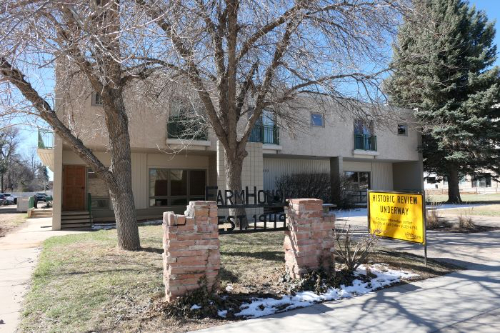
(Photo: LULAC Hall, 1975, Fort Collins Museum of Discovery.)
Upcoming Historic Preservation Commission Meetings

December Historic Preservation Commission work session and regular meeting CANCELED due to lack of business.

Next Work Session: Jan. 14, 2026, at 5:30 p.m., in person at City Hall (300 Laporte Ave., CIC Room). Public may attend, but no public participation occurs at work sessions.

Next Regular Meeting: Jan. 21, 2026, at 5:30 p.m., in person at City Hall (300 Laporte Ave., Council Chambers) or virtually via Zoom. Public may attend and provide comment.

Agenda:

  • Consent Agenda
    • Minutes of Nov. 19, 2025
  • Discussion Agenda: 
    • Staff Activity Report
    • Painted Masonry Policy Consideration
Learn More About the HPC

Historic Surveys

Surveys in Progress:
We are currently researching the following properties to determine if they are eligible to be Fort Collins Landmarks in association with a current development review application. Determinations of eligibility are based on the best available information today and are valid for five years. Members of the public with information regarding the history of these properties should contact Historic Preservation Services as soon as possible at preservation@fortcollins.gov.

  • None

Recent Survey Results: 

  • 120 E. Stuart St. – c. 1950, moved to site 1989, duplex – Additional permitted use for non-primary short-term rental; Not Landmark Eligible - Issued Dec. 23
  • 124 E. Stuart St. – c. 1939 single-unit dwelling – Project planning, no changes currently proposed; Not Landmark Eligible - Issued Dec. 23
  • 629 Stover St. – Triplex, moved onto the site in 1944, development review to certify triplex use; Not Landmark Eligible
  • 314 N. Howes St. - Commercial Building, c. 1960, City-owned property, advance planning; Not Landmark Eligible
  • 1513 N. College Ave. (K-Bar-D/Budget Host Motel) -1946-1973 (multiple buildings) - Demolition proposed (see demolitions section below), no development currently planned; Landmark Eligible

Single-Unit Dwelling Demolition (SUDDN) Notices

The City of Fort Collins requires public notification prior to the demolition of single-unit residences over 50 years of age. These notifications occur to inform neighbors of a potential change coming to their neighborhood and because certain groups can nominate a property for Landmark designation against the wishes of a property owner under Municipal Code Sec. 14-31 (the HPC by motion, a City Councilmember by written request, or three residents together by petition). Public noticing is considered complete the day after the HPC meeting for which it is noticed. Written public comments can be submitted to preservation@fortcollins.gov up to 48 hours prior to the HPC meeting for inclusion with the meeting packet. These notifications appear on the commission's discussion agenda, and an opportunity for spoken public comment will also be provided at the meeting. Visit the recently updated Single-Unit Dwelling Demolition Notification webpage for more detailed information on this process.

Active Demolition Notices:

  • None

Recently Completed Demolition Notices:

  • Standalone Demolition Notification (demo of commercial property with no development currently proposed) - 1513 N. College Ave. (K-Bar-D/Budget Host Motel), built 1946-1973, multiple buildings (1 public comment supporting proposed demolition at Nov. 19, 2025 HPC meeting; approval recommended by HPC to the decision-maker, the Chief Building Official, due to the extent of methamphetamine contamination)
  • 1617 Person Ct., built c. 1947 (no public comment at Aug. 20, 2025 HPC Meeting; no action taken by HPC)
  • 408 N. Loomis Ave., built c. 1906 (no public comment at May 21, 2025 HPC Meeting; no action taken by HPC)
  • 121 N. Whitcomb St., built c. 1895 (no public comment at May 21, 2025 HPC Meeting; no action taken by HPC)
  • 712 Scenic Dr., built 1975 (no public comment at April 16, 2025 HPC meeting; no action taken by HPC)

History Tidbit

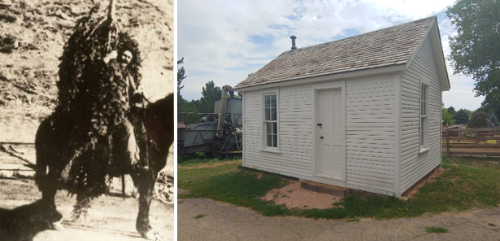
In 1890, James Ross, who immigrated from Scotland, built the "Proving-Up House" in the right image on his family farm around 1600 W. Horsetooth Rd. to meet the requirements of the 1862 Homestead Act. The Homestead Act enabled settlers to claim 160 acres of land taken by the U.S. government from Native Americans. Provided a homesteader "proved up the land," by farming and by building a minimum 10 by 12 foot residence on it, for example, they could receive the title to the acreage for free after a small filing fee. The Ross Proving-Up House is a City Landmark; you can check it out at the Farm at Lee Martinez Park, where it was moved in 2016 and restored in 2018.

The Ross family built a larger brick house in front of their small proving-up house in 1898. James Ross is pictured on the left, circa 1912. He traveled to the Walthen Ranch up Spring Canyon and carried down a Christmas tree on horseback for his daughter, Leona.

(Images: Left - "Christmas Tree on Horseback," Fort Collins Museum of Discovery, https://fchc.contentdm.oclc.org/digital/collection/ph/id/20075/rec/9; Right - Ross Proving-Up House, Historic Preservation Services, 2019)

Historic Preservation Services | preservation@fortcollins.gov | 970-224-6078
281 N College Ave
Fort Collins, CO 80524