News from Historic Preservation Services
Historic Preservation Matters Newsletter
Latest Updates
  • Nearby Volunteer Opportunity with HistoriCorps
    • HistoriCorps is a historic preservation non-profit based in Denver. This spring, HistoriCorps will head to the Arapaho and Roosevelt National Forests & Pawnee National Grassland to restore the historic Buckhorn Work Center, near Bellvue, about 45 minutes west of Fort Collins. Become a volunteer to learn and work alongside expert field staff to preserve an important historic resource while spending some quality time in the Rockies! There will be five week-long volunteer sessions between April 19 and May 22. Learn more about this volunteer opportunity and register here.
  • History Colorado and SPLASH NoCo Present: The Heritage for All Initiative
    • Help to identify and Landmark LGBTQ+ historic sites in Fort Collins and learn about local queer history! Join the next meeting on April 26, 6-8 p.m., at Prism (2721 S. College Ave., Unit 4A, hybrid option available) for an introductory presentation to the project. For questions and to RSVP, contact 970-444-5428.
  • Mark your calendars for May 5 to ring in Historic Preservation Month!
    • Show your support and celebrate at City Hall on May 5 at 5 p.m. for the reading of a proclamation declaring May Historic Preservation Month!

Are you the owner of a Fort Collins Landmark property?

Contact Historic Preservation Services (Preservation@FortCollins.gov; 970-224-6078) to learn more about financial support programs and for information on required design review of exterior alterations. Please remember that all exterior projects, including painting, require pre-approval and work that does not meet City code requirements is considered a violation and is subject to citation. We are here to help with project planning and look forward to hearing from you prior to the start of work!

Last Month's Historic Preservation Commission (HPC) Decisions

The March 2026 HPC meeting was canceled due to lack of quorum.

2026: The Year of Conversations
  • A Year of Conversations: In 2026, the United States celebrates 250 years of independence, and Colorado celebrates 150 years of statehood. The Fort Collins Museum of Discovery (FCMoD) and the City of Fort Collins invite the community to engage in learning, discourse, and the democratic process throughout the year with this event series, "A Year of Conversations." April and May events include:
    • Faith 250: America the Beautiful – April 7, 6-8 p.m. (LoveFirst Community, 2000 N. Lincoln Ave., Loveland)
    • Civic Saturday – April 11, 1-3 p.m., FCMoD (408 Mason Ct.)
      • Civic Saturdays, which originated in Seattle in 2016, give folks a space to build community with no strings attached. Whether a civic starting point, a refueling station, a spot for sense-making or celebration, Civic Saturdays help break down separateness and connect our hearts, inviting us to consider what it truly means to “live like a citizen” — and to commit to doing so, together. Please register to join in for Fort Collins’ first in-person Civic Saturday. There will be live music from Veronica May, poetry from local community members, and opportunities to connect with your neighbors.
    • Heritage Courtyard Open House – April 18 and May 30, 11 a.m. - 1 p.m., Heritage Courtyard at the Center for Creativity at the Historic Carnegie Library (200 Mathews St.)
      • This spring, FCMoD is highlighting the 1905 Upper Boxelder Creek Schoolhouse with an interactive open house for all ages. This event is free and open to the public—no tickets necessary, just drop in! 
        • Play: Try your hand at traditional 1900s games. 
        • Learn: Explore the architecture and stories of our one-room school.
        • Create: Participate in schoolhouse-themed activities and crafts. 
    • Speaking up for Cleaner Air – May 5, 6-8 p.m., FCMoD
      • Come listen to your neighbors share their stories of fighting for cleaner air in our community. Through personal stories and shared experiences, we’ll explore what it means to stand up for what we believe — and how to pass those lessons on to our kids. Head on over from City Hall after the Historic Preservation Month proclamation!
    • Brick by Brick: Historic Preservation, the Bicentennial Commission, and Civic Action – May 21, 7-8 p.m., FCMoD Digital Dome Theater (408 Mason Ct.)
      • Explore how the community came together to celebrate the bicentennial in 1976 and how it created momentum for historic preservation in our city. Bring your learning hat and your sense of civic pride as we explore stories from Fort Collins past that reflect the civic values of shared responsibility, memory, stewardship, and active citizenship of Fort Collins past, present, and future. The event is free, but tickets are limited. Reserve your spot and find more info on the event page.

Preservation Trades Workshops

Colorado Preservation Inc. (CPI) is offering hands-on preservation trades workshops year-round, connecting participants with the practical skills and traditional craft knowledge needed to care for historic buildings. 

As Colorado's statewide nonprofit dedicated to building a future with historic places, CPI's training opportunities support the growth of a strong preservation workforce while helping property owners, tradespeople, and community members learn time-tested techniques for maintaining historic resources. These workshops provide accessible, real-world learning guided by experienced professionals and partner organizations.

Upcoming Preservation Trades Workshops

Cost: $45 (CPI Members), $55 (Non-CPI Members)

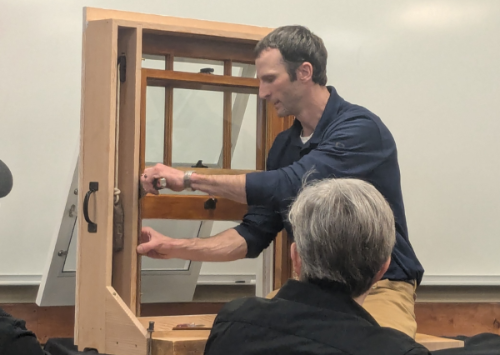
  • Wood Window Care and Tuning - Register online
    • Date: April 18, 2026
    • Instructed by: Deep Roots Craftsmen
    • Location: Nix Farm Natural Areas Facility, 1745 Hoffman Mill Rd., Fort Collins, CO 80524
    • Description: Historic wood windows are among the most sustainable building components ever made; they are highly repairable, long-lasting, and often superior to replacement options when properly maintained. But like any working system, they need regular care and occasional tuning to perform their best. In this hands-on workshop, participants will learn practical skills to improve window function, comfort, and durability, including sash adjustment, weatherstripping, reglazing, and basic repair techniques. Whether you own an older home or work on historic buildings, this session will give you the confidence to extend the life of original windows and keep them working for decades to come.

Happy Earth Month!

April is Earth Month—a great time to get outdoors and consider how we steward the world around us (it’s the only one we’ve got!). But did you know that saving historic places can be good for the planet, too? Many preservationists already know that preserving a building is a great way to conserve resources and energy. But historic places often come with historic landscapes that serve valuable environmental functions as well. In older historic districts, mature street trees provide shade (reducing urban heat and your energy bill), water filtration, and habitat for urban fauna, especially birds. Many historic residences come with gardens that can be great sources of food for pollinators—critical contributors to our food supply. Older farm properties sometimes still have orchards, which support biodiversity with heirloom fruit varieties.

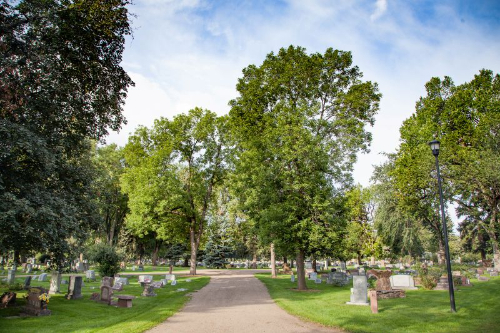
Let’s take a look at one of our larger historic landscapes. Many residents in Fort Collins may be familiar with Grandview Cemetery, developed in 1887 at the west end of Mountain Avenue as the final resting place for residents of Fort Collins. Maybe you’ve taken a stroll there, maybe you’ve driven past it on Laporte Avenue or Taft Hill Road, or maybe you have a family member or loved one resting there. Cemeteries are one of our most hallowed historic landscapes, but what a cemetery really means and what purpose it serves beyond just a resting place for those who’ve passed away has changed over time. Victorian era Americans loved to walk and picnic in cemeteries. After the 1970s, older cemeteries often became a scenic pathway for walkers and runners looking for a quieter way to get some exercise.

Grandview Cemetery is a City Landmark, in part because its history as a place for all of those uses. But did you know it’s a great place for birds, too?

Audubon International designated the cemetery as a Certified Audubon Cooperative Sanctuary through their Sanctuary Program, noting how important the landscape of the cemetery is for many bird species. Thanks mostly to the Cemetery’s historic trees of multiple varieties, birds find the landscape both quiet and sheltered. Among its more popular avian residents are a pair of Great Horned Owls, but other birds like Brown Creepers, Golden-crowned Kinglets, and Pine Siskins winter there in the evergreen trees. In the summer of 2005, birders spotted a Tropical Parula, the only time the bird had been seen in Colorado. Next time you’re in Grandview, maybe take a look up at the trees and see who else might be around.

(Photo: Grandview Cemetery, City of Fort Collins, 2017)

Historic Resource Spotlight

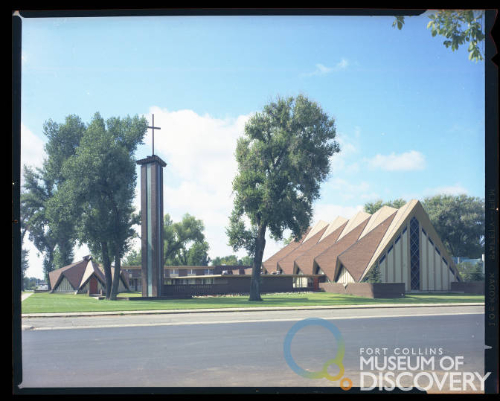
First Methodist Church (1005 Stover St.)

April is Architecture Month! Celebrate by learning about one of Fort Collins’ iconic mid-century modern churches—First United Methodist (1005 Stover St.).

The Methodists formed the first congregation in Fort Collins in 1864. For decades, they worshipped on the corner of College Avenue and Olive Street, expanding the church multiple times to accommodate their growing congregation, but by the late 1950s there was no more room.

Like many other religious institutions across the United States, the Methodist church’s membership had grown significantly after World War II. Participation in religious activities was considered an essential element of American life during this era, and historians suggest several reasons for this dramatic shift. Some point to the baby boom; selecting a religious institution and attending weekly services may have been a traditional rite of passage for the growing number of young families. Other historians note the threat of nuclear war caused a turn toward the safety of family, home, and religion.

In either case, as congregations grew, religious centers struggled to accommodate everyone who wanted to attend services within their pre-World War II buildings. Early twentieth century churches were generally located between residential and commercial areas; when those commercial areas expanded, religious centers found themselves surrounded by busy streets with no room for expansion. In addition, many congregants had moved away from city centers to outlying suburbs. Religious centers followed their members, buying large tracts of land in new suburbs or on the outskirts of town.

First United Methodist purchased a large plot of land at Elizabeth and Stover Streets in 1960. The site had previously supported the Colorado State University experimental farm; to prepare the site for construction, the farm’s headquarters building, a stone house along Garfield Street that had been home to two mayors and several early Fort Collins residents, was demolished.

William Robb, one of Fort Collins most prominent mid-century architects, designed the sprawling new church complex. His design featured a distinctive folded plate roof formed by 12 “folds” that created a triangular pattern; the pattern was repeated by triangular stained-glass windows under the eaves. The complex also included an octagonal chapel, two-story classroom wing, free standing tower, and offices. The total cost of construction was estimated at $900,000 (about $9.5 million in 2026). The church was completed in 1964 and could seat 800 attendees with overflow seating for an additional 500.

The church constructed a small addition in 1998, but the building remains almost exactly as it looked in 1964. It is eligible for listing as a local landmark and on the National Register of Historic Places but does not currently have any historic designations.

(Photo: Joe E. Clark, "First United Methodist Chuch - 1005 Stover Street, Fort Collins, Colorado," 1960s-1970s, H28858, FCMoD)
Upcoming Historic Preservation Commission Meetings

Next Work Session: April 8, 2026, at 5:30 p.m., in person at City Hall (300 Laporte Ave., Council Chambers). Public may attend, but no public participation occurs at work sessions.

Next Regular Meeting: April 15, 2026, at 5:30 p.m., in person at City Hall (300 Laporte Ave., Council Chambers) or virtually via Zoom. Public may attend and provide comment.

Agenda:

  • Consent Agenda
    • Minutes of Feb. 18, 2026
  • Discussion Agenda: 
    • Staff Activity Report
    • Conceptual Landmark Design Review - 638 Whedbee St. - Sunroom and covered deck addition
    • Historic Context Report: The Gateway to Fort Collins - The North College Corridor
    • HPC Rules Amendment Consideration - Presentation Order
Learn More About the HPC

Historic Surveys

Surveys in Progress:
We are currently researching the following properties to determine if they are eligible to be Fort Collins Landmarks in association with a current development review application. Determinations of eligibility are based on the best available information today and are valid for five years. Members of the public with information regarding the history of these properties should contact Historic Preservation Services as soon as possible at Preservation@FortCollins.gov.

  • 331 N. Loomis Ave. - c. 1903 residence - Project planning for potential subdivision application
  • 2112 E. Harmony Rd. – Harmony School and Teacherage – Landmark property designated 1997 – Survey for future project planning

Recent Survey Results: 

  • 3805 E. Vine Dr. - 1900 agricultural property - Development review for Natural Areas Department, long-range planning; Not Landmark Eligible - Issued Feb. 23, 2026
  • 1805 S. College Ave. - 1965 restaurant - Development review, major alterations proposed; Not Landmark Eligible - Issued Feb. 12, 2026
  • 3624 E. Mulberry St. - 1900 agricultural property - Development review for Natural Areas Department, long-range planning; Landmark Eligible - Issued Feb. 5, 2026
  • 1030 E Vine Dr/701 Lindenmeier Rd. – c. 1900 house and c. 1920 duplex – Development review, infill construction proposed – Landmark Eligible (c. 1900 house only) – Issued Jan. 29
  • 120 E. Stuart St. – c. 1950, moved to site 1989, duplex – Additional permitted use for non-primary short-term rental; Not Landmark Eligible - Issued Dec. 23

Demolition Notices

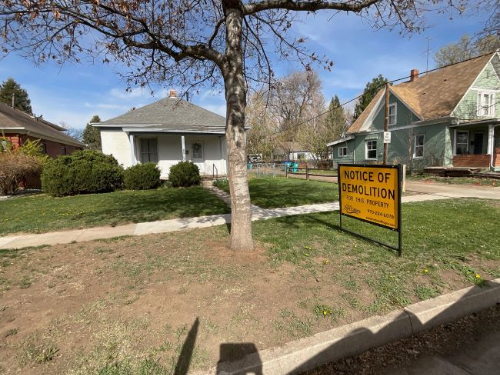
The City of Fort Collins requires public notification prior to the demolition of single-unit residences over 50 years of age, and we also provide notice on standalone demolition applications for commercial properties. These notifications occur to inform the community of a potential change coming to their neighborhood and because certain groups can nominate a property for Landmark designation against the wishes of a property owner under Municipal Code Sec. 14-31 (the HPC by motion, a City Councilmember by written request, or three residents together by petition). Public noticing is considered complete the day after the HPC meeting for which it is noticed. Written public comments can be submitted to Preservation@FortCollins.gov up to 48 hours prior to the HPC meeting for inclusion with the meeting packet. These notifications appear on the commission's discussion agenda, and an opportunity for spoken public comment will also be provided at the meeting. Visit the recently updated Single-Unit Dwelling Demolition Notification webpage for more detailed information on this process.

Active Demolition Notices:

  • None

Recently Completed Demolition Notices:

  • Standalone Demolition Notification (demo of commercial property with no development currently proposed) - 1513 N. College Ave. (K-Bar-D/Budget Host Motel), built 1946-1973, multiple buildings (1 public comment supporting proposed demolition at Nov. 19, 2025 HPC meeting; approval recommended by HPC to the decision-maker, the Chief Building Official, due to the extent of methamphetamine contamination)
  • 1617 Person Ct., built c. 1947 (no public comment at Aug. 20, 2025 HPC Meeting; no action taken by HPC)
  • 408 N. Loomis Ave., built c. 1906 (no public comment at May 21, 2025 HPC Meeting; no action taken by HPC)
  • 121 N. Whitcomb St., built c. 1895 (no public comment at May 21, 2025 HPC Meeting; no action taken by HPC)
  • 712 Scenic Dr., built 1975 (no public comment at April 16, 2025 HPC meeting; no action taken by HPC)

History Tidbit

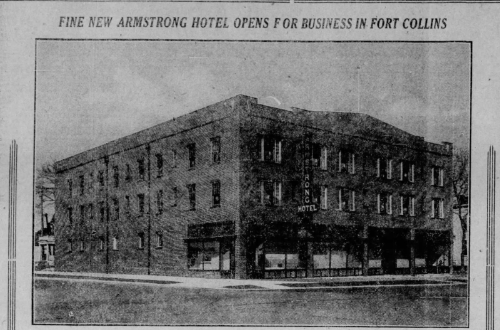
In the first week of April 1923, the Armstrong Hotel (259 S. College Ave.) opened for business. The three-story hotel features walls of Castle Rock striped and red brick and terra cotta coping. The interior was finished with mahogany woodwork throughout, and the lobby floor was terrazzo, a polished composite material of marble, granite, and concrete. The new hotel boasted eighty guest rooms, half with connected baths, and all with "hot and cold water, electricity and telephone service." The goal of the construction was "to provide the facilities for giving the best possible service and to make everything as comfortable as possible for patrons." Several businesses also called the Armstrong home, including Betty Jane Millinery, Milady's Beauty Shop, Smith's Sweet Shop, Piper and Jennings Barber Shop, Griffith and Wagner Billiard Room, J.A. Froid's Cigar and News Stand, Alex Edie's Flower Store, Mrs. E.M. Blaker's hemstitching business, as well as a ticket office for the Paradox bus line in the hotel lobby.

The Armstrong Hotel is designated as a Fort Collins Landmark and also on the State and National Registers.

(Image and content: "Fine New Armstrong Hotel Opens for Business," Fort Collins Courier, April 5, 1923.)

Historic Preservation Services | preservation@fortcollins.gov | 970-224-6078
281 N College Ave
Fort Collins, CO 80524